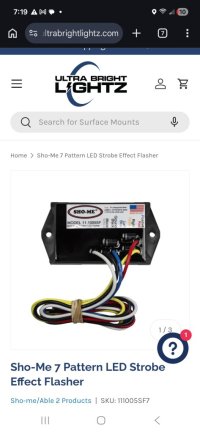
Bottom line up front, it might be better to use a solid-state headlight flasher designed for your specific vehicle instead of a stand-alone LED flasher.
Our shop found out the hard way how Dodge vehicles of that era were manufactured with an electronic "fuse box" called a TIPM (Totally Integrated Power Module). It was notorious for permanently shutting off circuits which shorted or back-fed the TIPM as a safety feature. If I recall, even the dealer's scan tool usually could not reset a hard shut down after so many (like 3-5) faults on a circuit. Obviously, things like a headlight or taillight flasher could kill a circuit on the TIPM in just a few seconds. The only solution they found was to have the dealer replace and reprogram a new TIPM on the vehicles and then omit the offending flasher.
To avoid killing circuits on the TIPM or other similar OEM controls, I would be very careful to electrically isolate any flashers from the OEM circuits.
You may want to consider adding diodes of sufficient ampacity wired inline to prevent the flow of current from the flasher back into the TIPM. You may also need another diode to prevent current flow into the flasher from doing odd things when the headlights are on, unless the flasher has internal isolation in its design.
A good quality headlight flasher usually has circuit isolation built into the device, but I don't know of any purpose-made headlight flashers that deliver a strobe-style flash pattern like you want.
The other thing to consider is if the LED retrofits you buy would even tolerate a rapid strobe flash altogether. Some may have been designed to limit visual flickering or the effects of PWM (pulse width modulation) used by OEMs for dimming or illuminating daytime running lights by electronically or logically smoothing voltage ripples. Thus, a strobe flash may not appear as intended when fed into the aftermarket LED headlight modules.
Here is a link to some guys discussing the diode issue that I found via a google search: